Conway’s Game of Life: a simple system with endless behavior
Conway’s Game of Life is a classic example of a cellular automaton: a grid-based system where complex patterns emerge from a few simple rules. Despite the name, it isn’t a game in the usual sense: there are no players, no scores, and no decisions once it starts. You choose an initial pattern, press start, and watch what unfolds.
The fascination comes from how rich and unpredictable the results can be, even though the rules never change.
What the Game of Life is
- The world is an infinite two-dimensional grid of square cells
- Each cell is either alive or dead
- Time advances in discrete steps called generations
- All cells update simultaneously based only on their immediate neighbors
Each cell considers its eight surrounding neighbors (horizontal, vertical, and diagonal).
The rules (B3/S23)
Every generation, the following rules are applied at the same time to every cell:
Underpopulation
A live cell with fewer than two live neighbors dies.Survival
A live cell with two or three live neighbors stays alive.Overpopulation
A live cell with more than three live neighbors dies.Reproduction
A dead cell with exactly three live neighbors becomes alive.
These are often summarized as:
B3 / S23
- B3 → Birth when a dead cell has 3 neighbors
- S23 → Survival when a live cell has 2 or 3 neighbors
That’s it. No randomness. No memory. No special cases.
Why it matters
From these rules, entirely different kinds of behavior appear:
- Still lifes that never change
- Oscillators that repeat in cycles
- Spaceships that move across the grid
- Guns that create other patterns indefinitely
- Methuselahs that begin small and evolve for hundreds or thousands of generations before stabilizing
The Game of Life is often cited in discussions of emergence, complexity, artificial life, and even computation, because it shows how structured behavior can arise without any central control.
Common named patterns
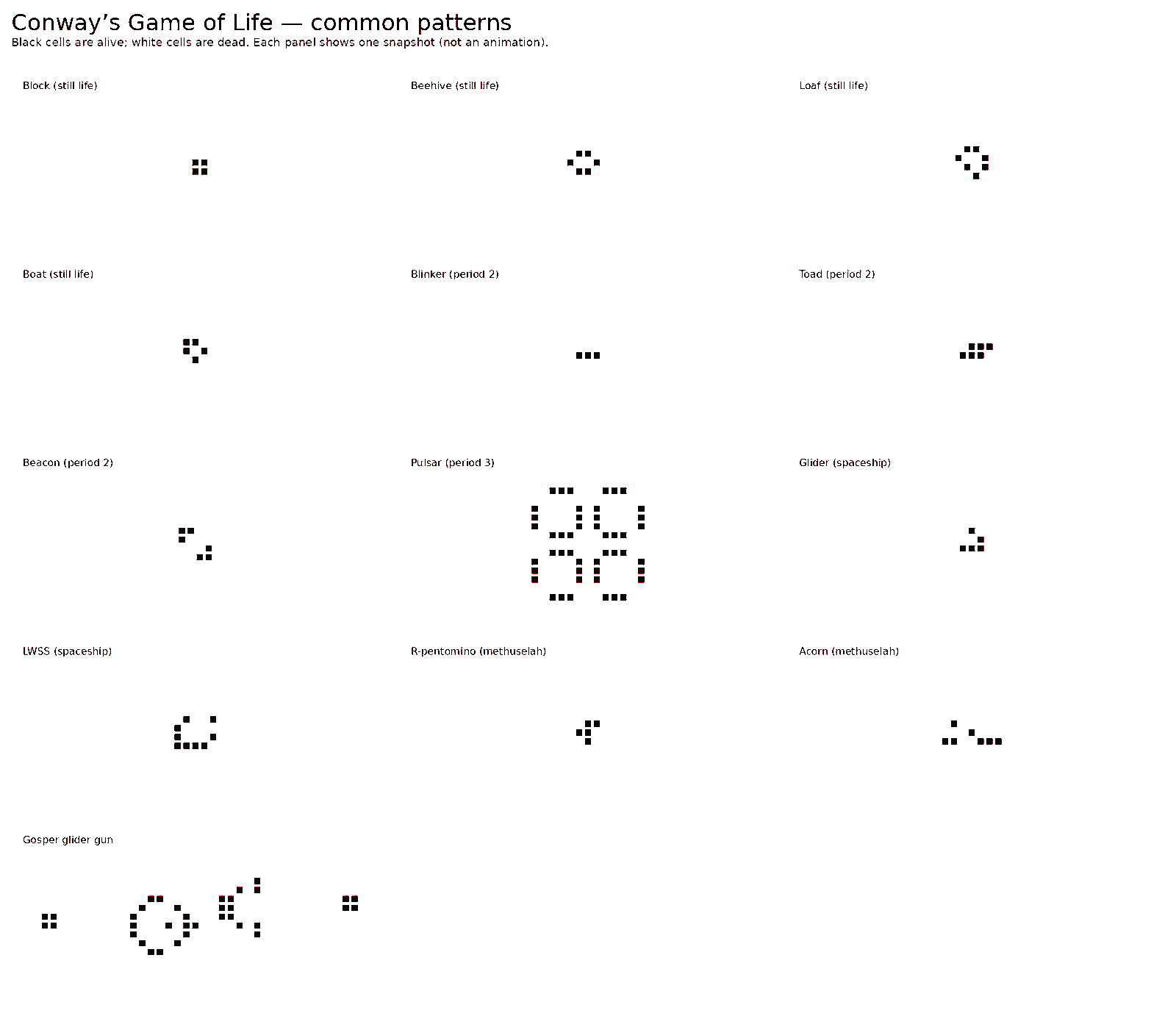
Below is a reference graphic showing several well-known Life patterns. Each panel is a single snapshot (not an animation). Black squares are alive cells; white squares are dead.
Included examples:
- Still lifes: Block, Beehive, Loaf, Boat
- Oscillators: Blinker (period 2), Toad (period 2), Beacon (period 2), Pulsar (period 3)
- Spaceships: Glider, Lightweight Spaceship (LWSS)
- Methuselahs: R-pentomino, Acorn
- Pattern generators: Gosper glider gun
A system that never runs out
What makes the Game of Life endure is that it never really “finishes.” New patterns are still being discovered decades after its invention, and small changes to the rules create entirely new universes of behavior.
All of that (movement, repetition, growth, collapse) comes from four rules and a grid.
That’s the quiet brilliance of the Game of Life.