No Taxation Without Representation. Unless Israel Needs Something.
There is something magnificent about 13 American state attorneys general threatening Great Britain with economic retaliation because Britain has decided what it will and will not trade with Israeli settlements.
Thirteen states.
THIRTEEN.
Apparently, the American Revolution was a temporary misunderstanding.
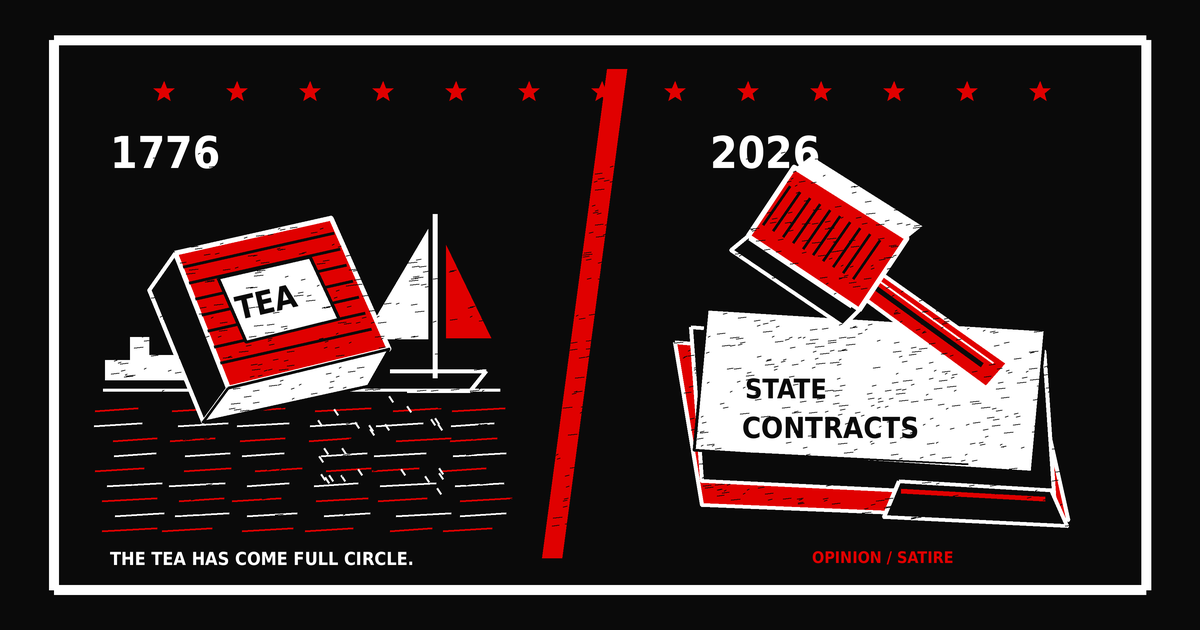
In 1773, Americans were dumping British tea into Boston Harbor because they objected to British interference in their economic affairs.
In 2026, American officials are threatening British commerce because Britain refuses to conduct certain economic activities involving Israeli settlements.
Somewhere, Samuel Adams is spinning in his grave fast enough to power Massachusetts.
And the really beautiful part? This isn't even about American territory.
It's about territory in the Middle East.
We have somehow arrived at the point where attorneys general from Iowa, Oklahoma and South Carolina are apparently responsible for defending Israel's settlement policies against the British Crown.
King George III would have loved this arrangement.
The sovereignty argument is where the comedy becomes exquisite.
The attorneys general argue that Britain and the Netherlands are interfering with Israel's sovereignty by attempting to influence its policies through economic sanctions.
Their solution?
Threaten Britain and the Netherlands with economic consequences until those sovereign countries change their policies.
That is the actual argument.
Foreign governments must not use economic pressure to influence another country's decisions.
And if Britain doesn't understand that principle, 13 American states will use economic pressure to make Britain understand.
You couldn't design a better circular argument with a drafting compass and a bottle of whiskey.
The contradiction is particularly apparent in the attorneys general's own letter, which warns that British and Dutch businesses could lose state contracts or face divestment. [source]
The American Revolution, revised edition
1776: We will not be ruled by a distant foreign power!
2026: We will not tolerate Britain refusing to do business with settlements in a distant foreign territory!
1776: No taxation without representation!
2026: No sanctions without approval from the Iowa attorney general!
1776: Give me liberty or give me death!
2026: Give Israel favorable trade treatment or we might reconsider your municipal procurement contracts!
Imagine explaining this to the Continental Congress.
Benjamin Franklin spends months in Europe securing international support for American independence.
Two and a half centuries later, American state attorneys general are writing threatening letters to European ambassadors about policies affecting Israeli settlements.
Franklin would have to put down his bifocals and ask which country had actually won the Revolution.
And then there's the economic logic.
Iowa Attorney General Brenna Bird argues that the European measures could damage American businesses.
Her office's proposed response includes potentially restricting business relationships with British and Dutch companies. [source]
So, to protect American businesses from the economic consequences of foreign restrictions, they are contemplating additional economic restrictions that could also affect American businesses.
This is the diplomatic equivalent of setting your own garage on fire because your neighbor won't lend you his lawn mower.
Of course, there is a legitimate legal question here. State anti-boycott statutes may impose restrictions on certain government contracts and investments. Whether the British and Dutch measures actually trigger those laws depends on their precise wording, how the laws define a boycott of Israel and which companies are involved.
But that makes the public threat even more interesting.
A British company's nationality does not automatically mean it is participating in a prohibited boycott. A government deciding not to import settlement products is also not necessarily equivalent to a private company boycotting Israel.
The legal distinctions are much more complicated than the political theater suggests.
The part that deserves serious attention
Three issues get lost beneath the comedy.
First, the distinction between Israel and occupied territory. Britain and the Netherlands are targeting settlement-related economic activity. The attorneys general characterize the restrictions more broadly as anti-Israel sanctions. Those are materially different descriptions, and the distinction matters legally. [source]
Second, federalism. American states can establish procurement and investment rules within applicable constitutional and statutory limits. They do not independently conduct national foreign policy or negotiate international trade agreements. Their ability to retaliate against foreign governments is therefore substantially narrower than the headline might suggest.
Third, the scope of American anti-boycott laws. Those laws create the possibility that actions taken by companies abroad could affect their eligibility for American state contracts. That is a genuine policy question concerning the interaction of domestic legislation, foreign policy and commercial freedom.
And that leads to the most important irony of all.
The attorneys general are defending Israel's right to determine its own policies while challenging Britain's right to determine its own trade restrictions.
They are invoking national sovereignty to justify interference with another nation's decisions.
They are warning against economic coercion while proposing economic coercion.
And they're doing it in the name of protecting American commerce, even though their proposed measures could restrict American commerce.
The whole thing is a constitutional law hypothetical written by Monty Python.
The closing argument
The original thirteen colonies declared independence from Britain because they wanted self-government.
Now thirteen American states are threatening Britain because Britain is exercising self-government in a way they dislike.
The number 13 is coincidental, but almost offensively perfect.
In 1776, thirteen colonies told Britain to mind its own business.
In 2026, thirteen states are telling Britain to mind Israel's business.
Somewhere along the way, Don't Tread on Me apparently acquired an exception for overseas real estate disputes.
And Thomas Jefferson's declaration that governments derive their just powers from the consent of the governed seems to have developed a footnote requiring approval from the attorney general of Iowa.
The American Revolution was fought to establish political independence from Britain.
Two hundred and fifty years later, Britain is apparently being informed that its independence is subject to review by Oklahoma.
The tea has come full circle.
And this time, the British aren't even the ones trying to sell it.